A New Proposal Series for Future Vision Launches!
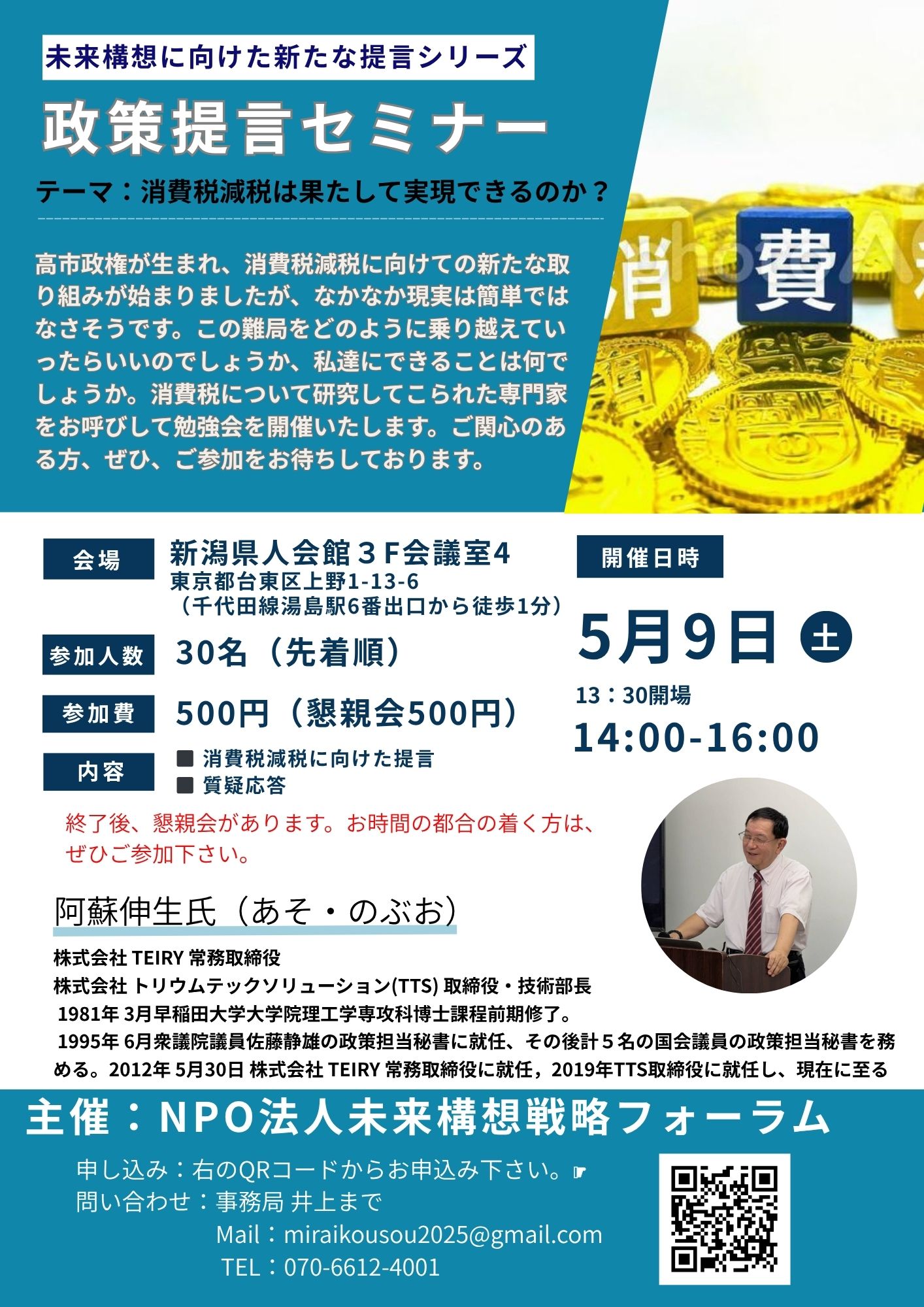
With the inauguration of the Takaichi administration, expectations for a consumption tax reduction are rising. However, significant hurdles remain to achieving it. In this seminar, we invite an expert who has studied this issue for many years to delve deeply into the feasibility of tax cuts and the path forward.
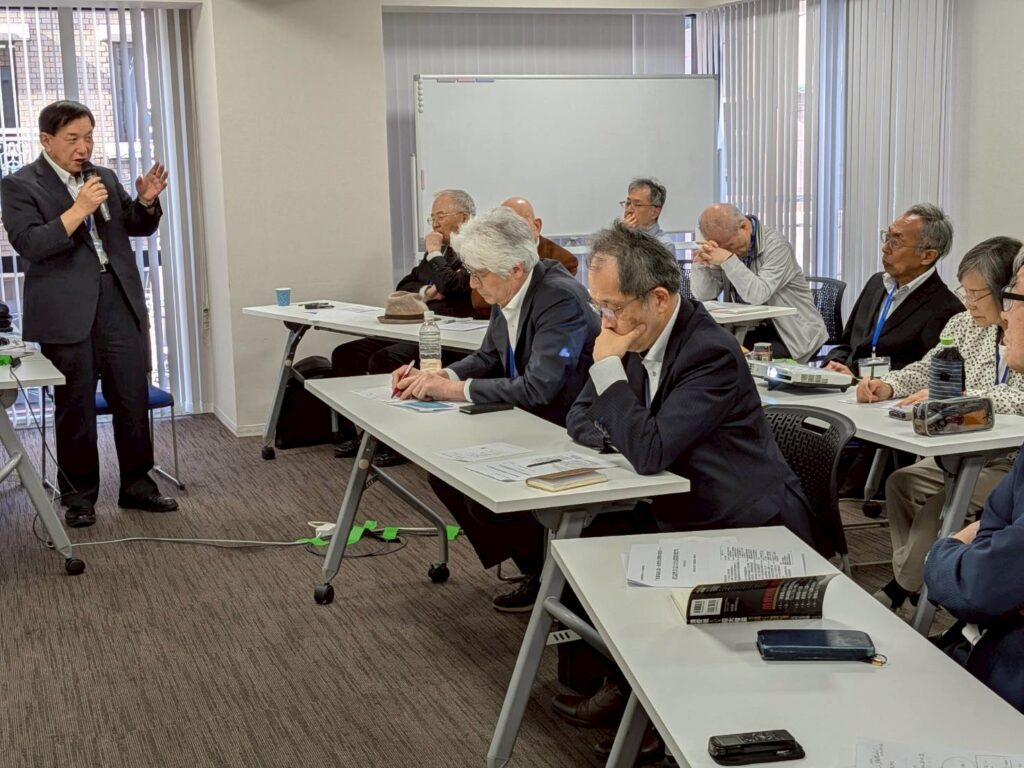
Seminar Videos
Summary of Seminar Part 1
1. The True Nature and Structural Flaws of the Consumption Tax
- Aspect as a "Value-Added Tax": The consumption tax is levied on "value added" (sales minus purchases), which inherently includes labor costs. Consequently, it effectively acts as a "penalty on personnel costs," creating a disincentive for companies to raise wages.
- A Heavy Burden on Unprofitable Businesses: Because tax liabilities arise even when a business generates no profit, it puts severe financial pressure on small and medium-sized enterprises (SMEs), contributing to bankruptcies and business closures.
2. Adverse Effects on Society (Why It Is Considered the "Root of All Evils")
- 25 Years of Deflation and Wage Decline: The analysis points out that the introduction and subsequent rate hikes of the consumption tax coincide directly with falling real wages and prolonged economic stagnation.
- Accelerating Birthrate Decline: Suppressed incomes and growing future anxiety among the youth are cited as decisive factors driving lower marriage rates and the declining birthrate.
- The Reality of Earmarking for Social Security: While tax hikes were justified under the banner of funding "social security," critics point out that the revenue has largely gone toward offsetting corporate tax cuts, failing to properly benefit the public.
3. Corporate Internal Reserves and Stagnant Investment
- Accumulation of Internal Reserves: As corporate taxes were cut, companies wary of consumption tax burdens suppressed personnel expenses and capital investments, leading to massive accumulations of internal cash reserves. This stands as a major factor stalling economic circulation.
4. "Abolition" as a Solution and Economic Revitalization
- Expansion of Nominal GDP: Abolishing the consumption tax directly increases disposable income, boosting consumer spending and lifting nominal GDP.
- Alternative Revenue Considerations: * Balancing tax cuts that stimulate capital investment with taxation on excess internal reserves.
- Natural increases in income and corporate tax revenues through economic growth.
- Conclusion: It concludes that "abolishing the consumption tax" is the single most effective prescription to break Japan out of deflation and restore vitality to working generations.
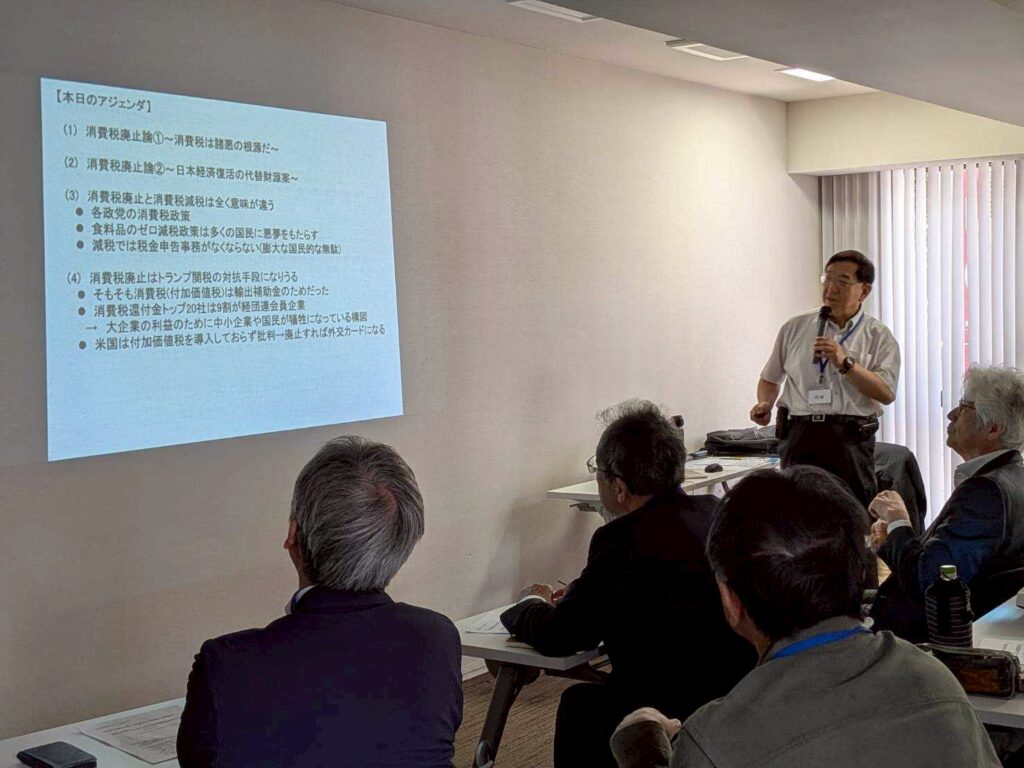
Summary of Seminar Part 2
1. The True Nature of Massive Inequity Caused by Export Tax Refunds
- Profits for Major Exporters: The presentation highlights how large export corporations, such as Toyota, receive hundreds of billions of yen in "export refunds" through the consumption tax system. This occurs because consumption tax paid on domestic procurement is treated as "0%" upon export, prompting refunds from the state.
- The Plight of SMEs: Conversely, SMEs unable to pass on costs to customers, as well as healthcare institutions ultimately forced to absorb the tax, face severe operational strains. The argument posits that the consumption tax is not a "tax held in trust," but functions in practice as a "second corporate tax" or a "turnover tax."
2. Historical Background of the Consumption Tax and Origins of the "Loophole"
- Influence of France and GATT: The value-added tax (VAT) was introduced by France in 1954. The presentation explains how it was originally designed as a mechanism to provide effective subsidies (refunds) to domestic firms while circumventing regulations on "export subsidies" prohibited under international trade rules (GATT) at the time.
- Introduction to Japan (Shoup Recommendation): It also touches upon post-war history, when a similar tax was initially recommended for Japan under the Shoup Recommendations but was shelved due to widespread criticism.
3. Distortions Across Various Sectors (Healthcare, Real Estate, Convenience Stores)
- Healthcare Institutions: Because medical care is exempt from consumption tax, hospitals cannot pass procurement consumption taxes on to patients. This gives rise to the problem of "non-deductible consumption tax," which healthcare facilities must absorb out-of-pocket.
- Convenience Store Franchises: The presentation explains the absurdity of how consumption tax artificially inflates owner costs in royalty calculations.
4. Conclusion: A Proposal to Abolish the Consumption Tax
- Although introduced under the guise of funding social security, the consumption tax functions heavily in practice to offset corporate tax cuts and subsidize major exporters.
- The presentation concludes that restoring healthy economic development and a fair tax system requires a fundamental overhaul aimed not merely at tax reduction, but at total abolition.
Event Overview
- Date & Time: Saturday, May 9, 2026, 14:00–16:00 (Doors open at 13:30)
- Venue: Niigata Kenjin Kaikan, 3F Meeting Room 4 (1-13-6 Ueno, Taito-ku, Tokyo)

Speaker Profile
Mr. Nobuo Aso
- Managing Director, TEIRY Co., Ltd.
- Director and General Manager of Technology Dept., Thorium Tech Solution Inc. (TTS)
Graduated with a Master's degree in Science and Engineering from Waseda University Graduate School in 1981. Served as Policy Secretary to House of Representatives member Shizuo Sato starting in 1995, subsequently serving as secretary to five members of the National Diet. Active across various fields as an expert intimately familiar with the frontlines of policy formulation.
3-Minute Summary! Easy Explanation
Simple ExplanationIs the "Consumption Tax" Really Necessary? What Happens If We Abolish It?
We pay "consumption tax" on everyday shopping. We are taught it supports seniors (social security), but this seminar discusses the question: "Could it actually be the cause of hardship for everyone in Japan?"
① What is the problem? (First Half of the Seminar)
- Wages become harder to raise: When companies pay higher wages, their tax burden tends to increase, making it difficult to raise employee salaries.
- Japan's economy remains stalled: Since the tax was introduced, Japan has faced long-standing stagnation in wages, consumer spending, and confidence regarding marriage and child-rearing.
- Taxing struggling businesses: Even small shops making no profit must pay consumption tax, driving many into closure.
② Is there an unfair system at play? (Second Half of the Seminar)
- Only big corporations benefit? (Export Refunds): Large exporters selling cars overseas receive hundreds of billions of yen in tax refunds from the government.
- Local shops and hospitals suffer: While major corporations benefit, local small businesses, convenience store owners, and hospitals bear a heavy tax burden.
③ What should be done? (Solutions)
- Rather than just reducing it, full abolition is the most effective remedy!
- Abolishing the tax makes shopping easier for everyone, boosting business sales!
- As companies thrive, parents' salaries will naturally increase.